
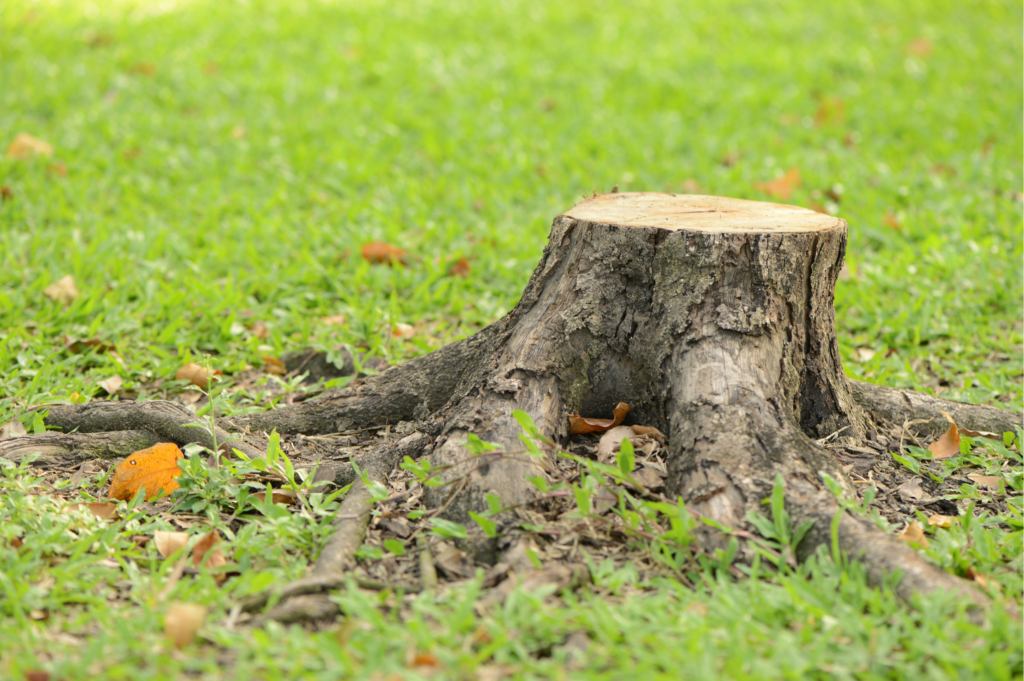
Why You Shouldn’t Leave That Tree Stump in the Ground
Once a tree comes down, it’s tempting to leave the stump where it is. It’s low, it’s out of the way, and it can always wait for another weekend.
In practice, an old tree stump tends to cause more trouble the longer it stays. Here’s why it’s usually worth dealing with, and what removal actually involves.
1. Stumps Can Grow Back
Many trees don’t die when they’re cut down. The roots are still alive and full of stored energy, so the stump sends up new shoots from the base or from roots nearby.
Poplars, willows, sycamores and some eucalypts are well known for it. Within a season you can end up with a cluster of fast-growing suckers that are harder to manage than the original tree.
Grinding the stump out below ground level removes the part most likely to reshoot.
2. They Attract Pests and Fungi
As a stump rots, it becomes a home for insects and fungi. Borer, ants and other insects move into the softening wood, and wood-decay fungi can take hold.
A decaying stump isn’t always a problem on its own, but it can bring pests closer to your house, deck or other trees. Some root-rot fungi, such as Armillaria, can also spread through the soil from an old stump to nearby healthy plants.
3. They Get in the Way
Stumps make lawns harder to mow, take up garden space and get in the way of landscaping, paving, fencing and building. On a Wellington section, where flat usable ground is often in short supply, that space matters.
If you’re planning a new garden bed, a deck or an extension, removing the stump first makes the rest of the job much simpler.
4. They’re a Trip Hazard
Low stumps are easy to miss, especially in long grass or after dark. They’re a common trip hazard for kids, visitors and anyone pushing a mower.
For landlords, property managers and commercial sites, clearing stumps from lawns and walkways is a simple way to reduce risk.
5. They Make a Property Look Unfinished
An old stump in the middle of the lawn makes a section look half done. If you’re getting ready to sell or rent, or you simply want the place to look tidy, removing stumps is an easy win for presentation.
How Stump Removal Works
Most stumps are removed by stump grinding. A grinder with a rotating cutting wheel chips the stump away into small woodchips, usually to around 200 to 300 mm below ground level. That’s deep enough to lay turf, replant or landscape over the area.
The woodchips can be spread as mulch or taken away. Large surface roots can be ground out too if they’re getting in the way.
Full extraction, where the whole root system is dug out, is sometimes needed for building work. It’s more disruptive, so it’s usually saved for sites where foundations or services are going in.
Can You Remove a Stump Yourself?
Small stumps from shrubs or young trees can often be dug out by hand. For anything bigger, DIY removal is slow, heavy work, and hired grinders can be dangerous if you haven’t used one before.
Chemical stump killers are another option, but they take a long time to work and don’t actually remove the stump. You’ll still be left with something to deal with later.
A professional stump grinding service is usually quicker, cleaner and safer, especially where access is tight or the stump sits close to fences, paths or buildings.
Stump Removal Across the Wellington Region
Advanced Arb removes stumps of all sizes across Wellington, Porirua, Lower Hutt, Upper Hutt and the Kāpiti Coast. We can grind out a single stump, clear several at once, or remove the stump as part of a full tree removal.
Find out more about our stump removal service or get in touch for a free, no-obligation quote.